
Fire-Resistant Roofing Systems
Class A protection, explained honestly — ratings, materials, codes, insurance, and the non-combustible aluminum system built for wildfire country.
TL;DR — The best wildfire roof is a Class A fire-rated assembly with a non-combustible covering. Interlock® aluminum shingles don’t ignite and don’t feed a fire — and when installed with two layers of GAF VersaShield® underlayment over a 15/32" plywood deck, Interlock Metal Roofing Systems can achieve a Class A fire rating, the highest standard for residential roofing in North America. Most homes lost in wildfires are ignited by wind-blown embers, not flames; a non-combustible interlocked metal roof is your home’s largest and most important ember shield. Class A roofs are required in California’s highest fire-severity zones and can qualify for insurance discounts of roughly 5–20% in a growing number of states.
Reviewed by the Interlock® technical team · Last updated July 22, 2026 · Every claim below links to its source.
Why Fire-Resistant Roofing Matters
The roof is the largest, most exposed surface of your home — and in a wildfire it is the primary target. Wind-blown embers can travel a mile or more ahead of the flame front, landing on rooftops, collecting in gutters and valleys, and entering at vents and edges. Post-fire research by the Insurance Institute for Business & Home Safety (IBHS) and state fire agencies consistently finds that most homes lost in wildfires are ignited by embers, not by the fire front itself.
The stakes are no longer theoretical. The January 2025 Los Angeles fires (Palisades and Eaton) destroyed roughly 16,000 structures — the costliest wildfire event in U.S. history — and roughly one-third of U.S. homes now sit in the wildland-urban interface (WUI), where structures and wildland fuels meet. Choosing a fire-resistant roofing system isn’t just a precaution. It’s the single biggest home-hardening decision you can make.
What “Class A” Actually Means — Standalone vs. By-Assembly
Roof fire ratings come from a standardized burn test — ASTM E108 / UL 790 — that measures three things: flame spread across the covering, resistance to a burning brand placed on the surface, and resistance to intermittent flame. Class A is the highest rating; Class B and C follow.
Here is the part of the story most roofing websites skip: there are two ways to earn Class A. Some coverings — clay tile, slate, most fiberglass asphalt shingles — carry a standalone Class A rating. Others, including metal panels, fire-retardant-treated shakes, and recycled rubber or plastic products, earn Class A by assembly: the covering is tested as a complete system with specific underlayment and deck components, as documented by the UC Agricultural & Natural Resources Fire Network.
Interlock earns its rating the by-assembly way — and only that way. When installed with two layers of GAF VersaShield® underlayment over a 15/32" plywood deck, Interlock Metal Roofing Systems can achieve a Class A fire rating — the highest standard for residential roofing in North America. Installed without that specified assembly, the system does not carry the Class A rating. Our systems are evaluated by the ICC Evaluation Service under ESR-1790 for fire classification, wind uplift, and weather resistance, with full testing reports published here. Ask your Interlock representative about the Class A fire-rated system configuration.
Why we tell you this: the rating that protects your home — and that your building inspector and insurer care about — is the rating of the installed assembly, not the bare material. Whoever roofs your home, ask for the tested Class A assembly in writing. It’s the question that separates real wildfire protection from a brochure claim.
Why Interlock Is the Best Choice for Fire Protection
Class A Fire Rated Available
The highest residential rating, with the specified VersaShield® assembly
Non-Combustible
Heavy-gauge aluminum won’t burn under extreme heat
Ember Resistant
Interlocked panels resist wind-blown wildfire embers
Lifetime Durability
Doesn’t warp, rot, or deteriorate over time
Energy Efficient
Reflective cool-roof surface lowers cooling costs
Eco-Friendly
High recycled aluminum content, fully recyclable
See It in a Wildfire Zone: Lake Country, BC
This black aluminum slate roof was installed on a home in Lake Country, BC — the wildfire-prone Okanagan interior. A drone tour of a real Class A fire-resistant Interlock system protecting a home where it matters most.
How Every Roofing Material Performs in a Wildfire
Ratings tell part of the story; behavior under ember attack tells the rest. Here is the honest comparison, material by material. For the buyer’s-guide version, see The Best Roof for Wildfire Zones.
| Roofing Material | Combustibility | Class A? | Wildfire behavior |
|---|---|---|---|
| Interlock aluminum shingles | Non-combustible | Yes — only as the tested assembly: 2× GAF VersaShield® over 15/32" deck (ESR-1790) | Does not ignite; interlocked panels resist ember entry at joints |
| Standing seam / steel metal | Non-combustible | Yes — typically by assembly | Does not ignite; performance depends on assembly and detailing |
| Asphalt shingles (fiberglass) | Combustible (petroleum-based) | Often, standalone | Rated versions can still ignite and degrade under sustained ember contact; aged, curled shingles trap embers |
| Clay / concrete tile | Non-combustible | Yes, standalone | Strong covering — but open barrel-tile ends admit embers unless bird stops are installed; tiles can crack under thermal shock |
| Recycled rubber (e.g. Euroshield®) | Combustible | Class C standalone; Class A only with special assembly | Rubber burns; UC ANR groups recycled products in the lowest rating class |
| Cedar shakes — untreated | Highly flammable | No (unrated) | The worst wildfire roof; banned in many WUI jurisdictions |
| Cedar shakes — fire-retardant treated | Combustible, treated | Typically Class B | Treatment weathers and degrades over time |
| Slate | Non-combustible | Yes, standalone | Excellent fire performance; weight and cost limit adoption |
Independent guidance on these classifications: UC ANR Fire Network, Fire Safe Marin, and FLASH.
Ember Science: How Homes Actually Ignite
Wildfire home loss is mostly an ember problem. Embers ride the wind ahead of the fire, then find the weak points of a structure:
- The roof covering — combustible coverings ignite directly; debris on any roof can ignite and spread to the structure.
- Edges, valleys, and roof-wall intersections — gaps and debris pockets where embers lodge. California’s WUI code specifies metal valley flashing (min. 0.019" galvanized, 36" wide) for exactly this reason.
- Gutters — dry leaves and needles are ember kindling attached to your roofline.
- Vents, skylights, and dormers — entry points for embers into the attic.
A hardened roof pairs a non-combustible Class A assembly with ember-resistant detailing and simple maintenance: keep gutters clean, clear debris from valleys, and screen vents. The IBHS Wildfire Prepared Home program and CAL FIRE’s Ready for Wildfire both build their standards around this roof-first logic.
Fire Codes & Insurance: What a Class A Roof Is Worth
Building codes in wildfire country
In California, Chapter 7A of the building code requires a Class A roof assembly for new construction in Very High Fire Hazard Severity Zones, along with ember-resistant vents and non-combustible detailing. WUI codes with similar roofing requirements are spreading across the West — Colorado, Oregon, Utah, Washington, Idaho, Montana, and parts of Texas have adopted or are adopting versions of the ICC’s wildland-urban interface code. If you are rebuilding or re-roofing in a mapped fire zone, a Class A assembly is increasingly not optional — it’s code.
Canada: FireSmart™, ULC ratings, and the National Building Code
Canada rates roof coverings under CAN/ULC-S107 — the Canadian counterpart to ASTM E108/UL 790, with the same Class A/B/C scale — and Interlock systems are evaluated for Canadian code compliance under CCMC 10475-R. FireSmart Canada — the national wildfire home-hardening program — puts the roof first in its construction guidance and recommends Class A fire-rated coverings such as metal for homes in the wildland-urban interface; FireSmart BC's Begins at Home guide carries the same roof-first checklist for the province where wildfire risk runs highest.
United States: insurance discounts, programs, and the ratings that earn them
Insurance is where fire-resistant roofing pays back every year. Three third-party ratings drive most roofing credits — and an Interlock system can carry all three:
| Rating | What it certifies | Insurance relevance |
|---|---|---|
| Class A fire (ASTM E108 / UL 790) | Highest resistance to flame spread, burning brands, and intermittent flame — as a tested assembly | Wildfire-mitigation discounts; required by some carriers to write policies in fire zones |
| UL 2218 Class 4 impact | Highest hail-impact rating (2" steel ball from 20 ft) | Separate impact-resistant-roof discounts, common in CO, TX, OK, MN — stackable with fire credits |
| Non-combustible construction | The covering itself cannot ignite or feed a fire | General fire-resistive construction credits offered by many carriers nationwide |
California leads with the Safer from Wildfires framework: admitted insurers must file wildfire-mitigation discounts, a Class A fire-rated roof is a listed measure, and documented discounts run roughly 5–20% depending on the insurer and how many measures you complete (Class A roof, ember-resistant vents, 0–5 ft noncombustible zone, cleared defensible space, and community-level programs). The IBHS Wildfire Prepared Home designation — a base and a “Plus” tier, both requiring a Class A roof — gives you a portable, inspector-verified credential; insurers such as Mercury now formally recognize it. Colorado’s HB25-1182 ties insurer risk models to property-level mitigation, and similar recognition is spreading across Oregon, Washington, and other WUI states.
How to actually collect: (1) get your Class A assembly documented in writing at install — covering, underlayment, deck; (2) photograph the install stages; (3) send the documentation to your insurer and ask specifically about wildfire-mitigation, impact-resistant-roof, and fire-resistive-construction credits — they are separate line items and can stack; (4) in eligible states, pursue the IBHS designation for the strongest, most portable proof. In hard-hit markets, a documented Class A assembly can be the difference between staying insured and being pushed to a state FAIR plan.
In Canada, wildfire-mitigation discounts are emerging rather than standardized: FireSmart BC works directly with insurers on recognizing mitigation, several carriers promote FireSmart measures to policyholders, and industry press notes that verified mitigation is not yet consistently priced — which cuts both ways: documentation of a ULC-rated, non-combustible roof assembly is exactly what positions Canadian homeowners to benefit as recognition spreads, and metal roofs already commonly qualify for general fire-resistance credits with Canadian insurers. After record seasons like 2023 (the most area ever burned in a Canadian wildfire season) and the 2024 Jasper fire, insurability in fire-exposed regions is moving the same direction as the U.S. — toward rewarding hardened homes.
What Survived the 2025 Los Angeles Fires
After the Palisades and Eaton fires, investigators and journalists documented a consistent pattern: the homes still standing were overwhelmingly hardened homes — Class A roofs, ember-resistant vents, cleared defensible space. Fire-resistant construction doesn’t guarantee survival, but the 2025 fires demonstrated at devastating scale that it shifts the odds dramatically. The roof you choose today is the decision your home rides out the next fire on.
Performance Specifications
| Specification | What it protects against |
|---|---|
| Wind resistance: 120+ mph (193+ kph) | Extreme wind, hurricanes, storm uplift: full interlocking attachment helps prevent blow-offs, edge lifting, and panel loss in high-gust events. |
| Fire rating: Class A (with proper assembly) | Wildfire, embers, radiant heat, chimney sparks: non-combustible roof assembly provides the highest residential fire protection rating. |
| Hail resistance: UL 2218 Class 4 | Hail and impact debris: highest impact classification; resists cracking, splitting, and surface loss common with asphalt under hail strikes. |
| Snow & ice performance: interlocking, shedding profile | Heavy snow, freeze-thaw, ice dams: smooth aluminum sheds snow efficiently and the interlocking design helps block water intrusion when melt-refreeze cycles occur. (Final snow-load capacity depends on roof structure and local code.) |
| Corrosion resistance: aluminum (won’t rust) | Salt air, coastal humidity, wet climates: aluminum naturally resists rust and corrosion, reducing long-term failure risk in marine or high-moisture environments. |
| Heat / UV durability: baked-on coating system | High heat, intense sun, thermal cycling: coatings resist UV breakdown and temperature-swing fatigue, slowing fading and surface degradation. |
| Moss / algae resistance: smooth coated surface | Wet shade, organic growth: low-porosity metal surface gives moss/algae less to grip, reducing staining and maintenance. |
| Material: heavy-gauge aluminum roof profiles (Slate / Shake / Shingle / Tile / Standing Seam) | All-season structural stability: lightweight, dent-resistant metal system stays stable through large hot-cold swings and severe weather. |
| Expected lifespan: 50+ years | Long-term durability across climates: avoids re-roof cycles typical of shorter-life materials, even in high-stress environments. |
| Warranty: Lifetime-Limited, non-prorated + 50-year transferable | Lifetime protection + resale value: guarantees long-term material confidence and transfers to future owners. |
Get Started
Get a Free Fire-Resistant Roofing Estimate
A specialist will assess your home's wildfire exposure and recommend the right Class A assembly.
- A response to your enquiryAn Interlock representative or independent installer, depending on your location, follows up about your project.
- A free on-site assessmentDiscuss an assessment of your roof, deck and ventilation, and the profiles and colors available for your project.
- A written, itemized quoteConfirm the contracting company, scope, price, applicable manufacturer warranty and installer workmanship coverage before proceeding.
No obligation to purchase. Marketing subscriptions are optional.
Prefer to talk? 1-866-733-5811
Request Your Free Quote
Tell us about your project so we can check installation options in your area.
FAQs About Fire-Resistant Roofing
What is the best roof for wildfire areas?
A Class A fire-rated roof assembly with a non-combustible covering — metal, clay/concrete tile, or slate — installed with sealed edges, ember-resistant detailing, and clean gutters. Non-combustible metal systems like Interlock aluminum shingles combine the Class A assembly rating with interlocking panels that resist ember intrusion at the joints. See our full comparison of materials above and the deeper guide in our knowledge base.
What makes Interlock Metal Roofing fire-resistant?
Interlock roofs are made from non-combustible heavy-gauge aluminum that does not ignite or spread flame. When installed with two layers of GAF VersaShield® underlayment over a 15/32" plywood deck, Interlock Metal Roofing Systems can achieve a Class A fire rating — the highest standard for residential roofing in North America. The rating applies to that tested assembly specifically.
What does “Class A by assembly” mean?
Under ASTM E108 / UL 790, some coverings earn Class A on their own (“standalone”), while others — including metal panels, fire-retardant shakes, and recycled products — earn it as a tested system with specific underlayment and deck components (“by assembly”). Interlock can achieve Class A only as its tested assembly: two layers of GAF VersaShield® underlayment over a 15/32" plywood deck. What matters to your home and your insurer is the rating of the installed assembly, not the bare panel — always ask any roofer for the tested assembly, not just the material rating.
Is a metal roof fireproof?
No roof is “fireproof” — the correct term is fire-resistant. Aluminum is non-combustible: it does not ignite, feed a fire, or shed burning debris. In a wildfire, the roof covering’s job is to reject wind-blown embers and resist radiant heat long enough to prevent ignition — which is exactly what a Class A non-combustible assembly is tested to do.
Do embers really ignite roofs?
Yes — research from IBHS and post-fire investigations consistently find that most homes lost in wildfires are ignited by wind-blown embers, not the flame front. Embers can travel a mile or more ahead of a fire and collect on roofs, in gutters, and at vents. That is why a non-combustible roof covering, ember-resistant detailing, and debris-free gutters are the first line of defense.
How does Interlock compare to asphalt shingles for fire resistance?
Asphalt shingles are petroleum-based and can ignite under sustained ember exposure; ratings vary by product and underlayment, and aged or curled shingles create ember traps. Interlock aluminum is non-combustible — it does not ignite — and helps slow fire spread, buying precious time.
Is a Class A roof required in California fire zones?
In Very High Fire Hazard Severity Zones, California’s Chapter 7A wildland-urban interface (WUI) building code requires a Class A roof assembly, along with ember-resistant vents and other hardening measures. Other western states (Colorado, Oregon, Utah, and more) are adopting WUI codes with similar roofing requirements — check your local jurisdiction.
Will a fire-resistant roof lower my homeowner’s insurance costs?
Increasingly, yes. Under California’s “Safer from Wildfires” framework, admitted insurers must file wildfire-mitigation discounts, and a Class A fire-rated roof is a listed measure; documented discounts range roughly 5–20% depending on insurer and measures completed. Insurers are also beginning to recognize the IBHS Wildfire Prepared Home designation, which requires a Class A roof. Benefits vary by provider and state — ask your insurer about non-combustible roofing credits.
What about Canada — fire ratings and insurance for wildfire zones?
Canada rates roof coverings under CAN/ULC-S107, the Canadian counterpart to the U.S. Class A/B/C standard, and Interlock systems are evaluated for Canadian code compliance under CCMC 10475-R. FireSmart Canada — the national wildfire preparedness program — puts the roof first in its home-hardening guidance and recommends Class A fire-rated coverings such as metal. Canadian insurer discounts for wildfire mitigation are emerging rather than standardized, but metal roofs commonly qualify for general fire-resistance credits — ask your insurer, and keep documentation of your rated assembly.
Do metal roofs attract lightning?
No. Lightning strikes the tallest object in an area regardless of material, and a metal roof does not increase the odds of a strike. If lightning does strike, a non-combustible metal roof is actually safer than a combustible one — it disperses energy and cannot ignite.
Is Interlock Metal Roofing suitable for homes in all climates?
Yes. The same system that resists fire also withstands hurricane-force winds, heavy snow, hail and coastal salt air — tested across North America and proven from Florida to Alaska, and even Antarctica.
The Great Fire of 1830: Past Lessons, Present Protection in Gloucester, MA
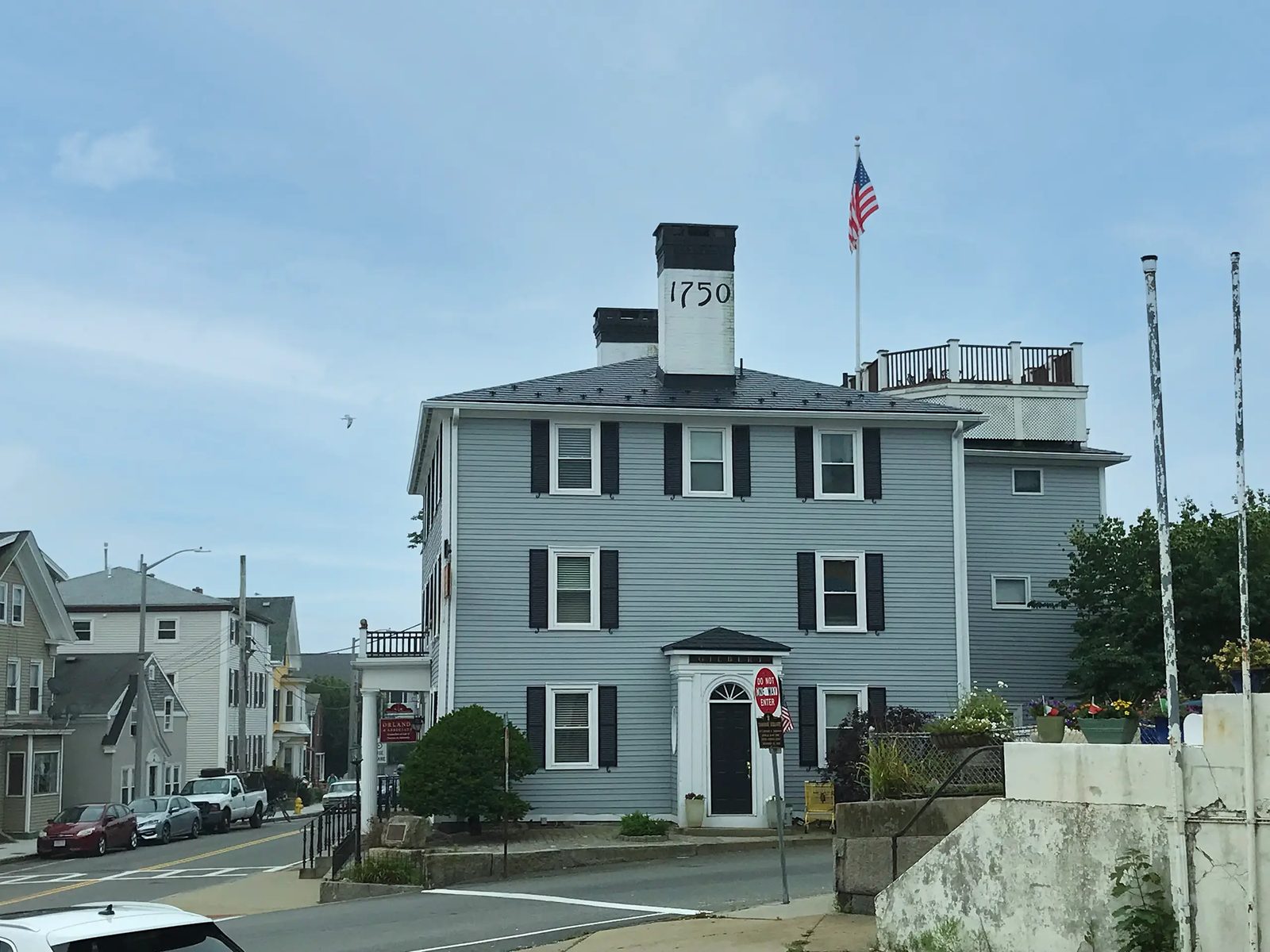
Although Gloucester purchased its first fire engines in 1793, it was the catastrophic "Great Fire of 1830" that served as a wake-up call. On September 16, 1830, a house owned by Mr. Samuel Gilbert on the western end of Front Street caught fire. The blaze quickly spread, engulfing at least 27 dwelling houses and 43 stores and workshops, from the town landing to Porter Street.
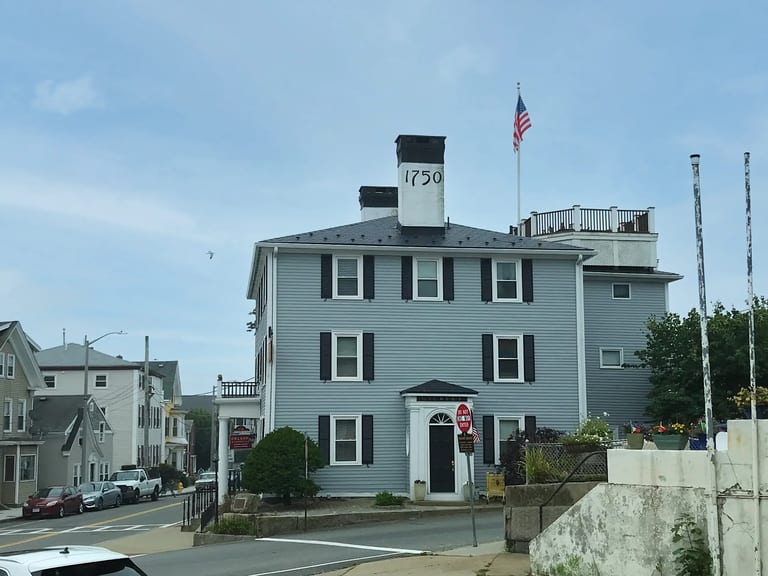
The Samuel Gilbert House — originally built in 1750 by Nathaniel Ellery — stands today at the corner of Angle Street and Western Avenue. The historic structure now features an Interlock® aluminum slate roofing system: a fire-resistant roof that exemplifies today's commitment to fire safety in historic preservation, protecting the town's architectural heritage while safeguarding its community.
Don't wait until it's too late. Upgrade to a fire-resistant roof that stands the test of time.
Free Consultation